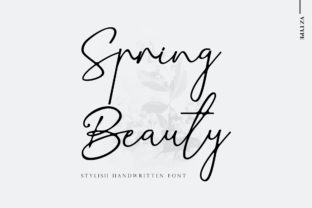
Spring Beauty: Elevating Your Creative Projects with a Handwritten Script
In the crowded digital landscape, where generic templates and mass-produced designs often blend into a sea of sameness, finding a font that truly captures attention is essential. Spring Beauty stands out as a handwritten script font defined by its simple yet classy style. It is not merely a typeface; it is a tool designed to elevate your work to the highest level. Whether you are a professional photographer adding a watermark, a small business owner designing business cards, or a blogger crafting album covers, this font offers a touch of elegance that can transform ordinary projects into memorable experiences.
However, simply downloading a beautiful font does not guarantee success. Many creators rush to use Spring Beauty without understanding its nuances, leading to results that look amateurish rather than refined. To help you avoid these pitfalls, we need to look at how to properly evaluate, apply, and maximize the potential of this specific typeface.
Understanding the True Value of Spring Beauty
When people search for a "handwritten script font," they often expect chaotic, messy, or overly decorative lettering. Spring Beauty breaks that mold. Its strength lies in its simplicity. It mimics the fluidity of human handwriting but maintains a structured, legible form that feels sophisticated. This balance makes it incredibly versatile for various applications.
If you are creating content for social media, a quote overlaid on an image using this font can instantly convey warmth and authenticity. For branding purposes, such as logos or watermarks, the clean lines ensure that your name remains readable even when scaled down or placed over complex backgrounds. The key here is recognizing that Spring Beauty is about subtlety. It should enhance your design, not overpower it.
Common Mistakes When Using Script Fonts
Even experienced designers can fall into traps when working with script fonts like Spring Beauty. These errors often stem from a lack of attention to detail regarding context and spacing. Below are the most frequent misunderstandings and how they negatively impact your final output.
- Overusing the Font: One of the biggest mistakes is trying to make every element of a design a headline. Using Spring Beauty for long paragraphs of body text is a recipe for unreadability. Scripts are meant for emphasis, titles, and short phrases. If you force it into dense blocks of text, your audience will struggle to read your message, defeating the purpose of clear communication.
- Neglecting Kerning and Spacing: Handwritten styles rely heavily on the connection between letters. A common error is applying default spacing settings. In Spring Beauty, if letters are too far apart, the "handwritten" illusion breaks, making the text look disjointed. Conversely, if they are too close, characters may merge, creating confusion. Proper kerning is vital for maintaining the flow and elegance of the script.
- Poor Contrast and Legibility: Placing white Spring Beauty text on a light background or dark text on a busy, high-contrast photo is a classic mistake. While the font is elegant, it lacks the bold weight of sans-serif fonts used for headlines. If the contrast isn't sharp, your watermark might disappear, or your logo might fail to register visually. This directly affects brand recognition and the professional quality of your presentation.
- Ignoring the Vibe Match: Not every project suits a script font. Using Spring Beauty for a tech startup's landing page or a financial report can create a jarring disconnect. The font conveys creativity, personal touch, and softness. Applying it to rigid, corporate, or industrial themes can confuse your audience about your brand identity.
The Impact on Professional Perception
These mistakes do more than just look bad; they affect the efficiency and cost of your workflow. A design that requires constant tweaking because of poor legibility takes longer to finalize. Worse, a client or customer who cannot easily read your message may lose trust in your professionalism. In marketing, clarity is king. If your Spring Beauty typography obscures your call to action, your conversion rates will suffer.
How to Avoid Pitfalls and Maximize Quality
To ensure your projects benefit from the classy style of Spring Beauty, adopt a methodical approach before you start typing. Here is practical advice on how to navigate the selection and application process effectively.
- Check the License Before You Download: Always verify the licensing terms associated with Spring Beauty. Some fonts are free for personal use only, while others require a commercial license for business cards, logos, or monetized videos. Using a font without the proper rights can lead to legal issues and unexpected costs later. Ensure you have the correct permission for your specific project type.
- Test for Readability First: Before committing to a full design, type out your main message in Spring Beauty and view it at different sizes. Can you read it clearly on a mobile screen? Does it remain distinct when printed on a business card? If the answer is no, consider adjusting the size, color, or adding a subtle shadow or stroke to improve visibility.
- Pair with Complementary Fonts: Never let Spring Beauty work alone unless it is the sole focus of the piece. Pair it with a clean, neutral sans-serif font for supporting text. For example, use Spring Beauty for a wedding invitation title and a simple geometric font for the date and location. This contrast creates a hierarchy that guides the viewer's eye naturally.
- Adjust Weight and Opacity: If you are placing the font over a photograph, do not assume the default opacity works best. Lowering the opacity slightly or changing the color to a complementary shade (like a deep navy instead of pure black) can help the text sit better within the image without losing its character.
Evaluating Your Design Choices
Before finalizing any project, ask yourself critical questions. Does the font reflect the tone of the message? Is the spacing consistent throughout the word? Does the text stand out against the background? By pausing to evaluate these factors, you prevent the frustration of having to redo work due to usability issues.
Spring Beauty is a powerful asset for creatives looking to add a personal touch to their work. From photography watermarks that protect your art while looking stylish, to album covers that promise a unique listening experience, this font delivers. However, its success depends entirely on how thoughtfully you apply it. Avoid the trap of using it indiscriminately. Instead, treat it as a special ingredient—used sparingly and correctly, it elevates your entire composition.
Whether you are a freelancer pitching to a new client, a blogger sharing quotes, or a hobbyist designing invitations, taking the time to understand the mechanics of Spring Beauty will pay off. By focusing on readability, proper spacing, and appropriate context, you ensure that your designs communicate your message clearly and beautifully. Remember, the goal is not just to use a pretty font, but to create a cohesive, professional, and engaging visual experience.